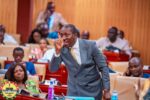

The Lambussie District Assembly has accounted for its development activities, financial resources and revenue performance for the 2025–2026 period as part of the Upper West Regional Minister’s “Accounting to the People Tour” held in the district.
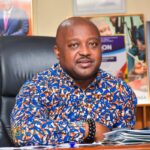
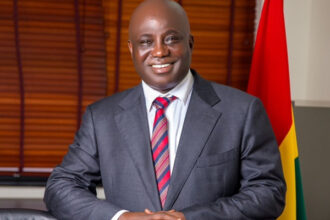
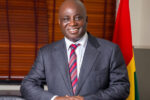
The programme took place on Thursday, November 19, 2026, at the Lambussie District Library, where the District Chief Executive (DCE), Hon. Ireneous N. Basingbie, presented an overview of the Assembly’s development priorities and projects to the people.
One of the major projects highlighted was the construction of the Hamile Model Market, which has a contract sum of approximately GH¢30.98 million. According to the DCE, the project has so far achieved only 5 percent completion, with GH¢539,000 paid as of the period under review.
The project, which is being funded through the District Assemblies Common Fund (DACF), is expected to improve internally generated revenue, enhance service delivery and promote local economic development in the district. Its expected completion date is September 2029.
On revenue mobilisation, the Assembly disclosed that it had set an Internally Generated Fund (IGF) target of GH¢566,516.58 for 2026, but had mobilised GH¢301,608.38, representing approximately 53 percent of the annual target.
The Assembly identified inadequate databases on ratable properties, the continued use of manual systems for recording revenue receipts, limited use of technology, capacity challenges and the absence of an appropriate revenue management system as some of the factors affecting revenue mobilisation.
The DCE also reported that the Assembly received GH¢10.03 million from the District Assemblies Common Fund (DACF) in 2026, out of which about GH¢6.04 million had been utilised during the period under review. The Assembly also received funding through other sources, including DACF-RFG, the Member of Parliament’s DACF allocation and other government-assisted programmes.
In the area of education, the Assembly reported the completion of several projects aimed at improving access to quality education. These included a three-unit classroom block at Kelegan, two-unit KG blocks at Tayaguri and Nyubule, a three-unit JHS classroom block at Nabaala, and the rehabilitation of JHS blocks at Dahile-Kunta and Gbingbalala.
The Assembly also procured 400 mono desks, 350 dual desks and 50 hexagonal desks for distribution to schools across the district at a contract value of GH¢1.22 million, with the project reported as substantially completed.
In the health sector, the Assembly completed and handed over CHPS compounds at Muoteng and Liero, with contract sums of approximately GH¢548,030 and GH¢547,026 respectively. The projects are expected to improve access to healthcare delivery in the beneficiary communities.
The Assembly further reported that construction of a medical theatre at the Hamile Polyclinic had reached 80 percent completion, while construction of another CHPS compound at Buu was also reported to be 80 percent complete.
The district also benefited from water and sanitation interventions. The Assembly completed the drilling and installation of nine boreholes with hand pumps in a number of communities, including Muoteng, Samoa, Suke, Sentu, Piina, Kelegaun and Busigya, to improve access to potable water.
Development partners also contributed significantly to infrastructure development in the district. SNV supported the construction of 13 boreholes and four KVIPs, while five incinerators were constructed for selected health facilities.
On security and border surveillance, the Assembly reported receiving support from IOM/CSSM, including two vehicles, 20 motorbikes and furniture for the District Assembly, Area Councils, the Police Command and the Immigration Service. The support is intended to improve security and strengthen surveillance, particularly around the border.
The DCE identified delays in the release of funds from central government, low internally generated revenue, inadequate early childhood educational infrastructure and low local economic development activities as some of the major challenges confronting the district.
Going forward, the Assembly says it will pursue strategies to diversify local economic development activities, improve revenue mobilisation, ensure strict implementation of the District Medium-Term Development Plan and prioritise early childhood educational infrastructure.
The Accounting to the People Tour therefore provided an opportunity for the Lambussie District Assembly to account to residents for public resources received, projects undertaken, development challenges and measures being pursued to improve service delivery and development outcomes in the district.